
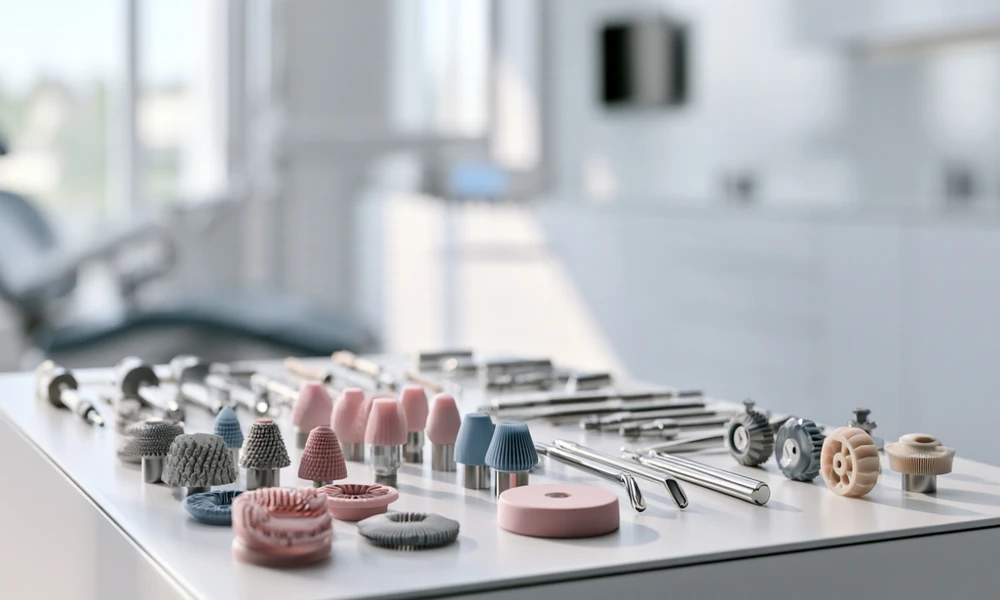
Achieving a smooth, polished surface is an important part of many dental procedures. Proper finishing and polishing can improve the appearance of restorations while helping create a more refined surface. Selecting the appropriate rotary instrument is therefore an important consideration for dentists, hygienists, and dental laboratory professionals.
Dental polishers are designed to help smooth, refine, and polish various dental materials and tooth surfaces. They are available in different shapes, materials, grits, and configurations, allowing professionals to select instruments according to the procedure and material being treated. Understanding these differences can make it easier to choose the right option for a particular application.
What Are Dental Polishers?
Dental polishers are rotary instruments used during the finishing and polishing stages of dental procedures. Depending on their design, they may be used on natural teeth, composite restorations, ceramics, acrylics, metals, and other dental materials.
Unlike cutting burs, which are primarily designed for removing material, polishers are generally intended to refine surfaces and create a smoother finish. They can be used with different types of handpieces and are often available as discs, cups, wheels, points, or other specialized shapes.
Factors to Consider When Choosing a Polisher
Selecting a suitable polisher involves more than simply choosing a familiar shape. Several factors can influence performance and the final result.
Consider the Material
The material being polished should be one of the first considerations. Different materials require different levels of abrasiveness and polishing systems.
For example, a polisher designed for composite resin may not be the best option for ceramics or metal restorations. Always check the manufacturer’s recommendations to ensure that the instrument is suitable for the intended material.
Choose the Appropriate Grit
Polishers are commonly available in different grit levels. Coarser options can be useful for initial refinement, while finer grits are generally used to achieve a smoother final surface.
A typical polishing sequence may involve:
- Coarse polishing for initial contouring
- Medium grit for surface refinement
- Fine grit for smoothing
- Extra-fine polishing for a higher surface shine
Using the appropriate progression can help create a consistent finish without unnecessarily removing material.
Common Types of Dental Polishers
Different polisher designs are suited to different applications. Understanding their basic characteristics can help simplify instrument selection.
Cups and Points
Cup-shaped polishers are often useful for polishing curved or accessible surfaces, while pointed designs can help reach smaller or more detailed areas. Their flexibility makes them useful for various restorative and preventive procedures.
Discs and Wheels
Discs can provide greater control when working on flat or contoured surfaces. They are commonly used for shaping and polishing restorative materials, particularly when access and surface visibility are important.
Wheels can be useful for broader areas and specific laboratory applications. Their shape allows the operator to work across surfaces efficiently while maintaining control.
Material-Specific Polishers
Some polishing systems are manufactured specifically for materials such as composites, ceramics, acrylics, or metals. These instruments may use specialized abrasive materials to produce the desired surface finish.
Tips for Effective Polishing
Proper technique can be just as important as selecting the right instrument. Follow the manufacturer’s recommended speed and use appropriate pressure during the procedure.
Avoid excessive pressure, which may generate heat, damage the restoration, or shorten the useful life of the polisher. Using a controlled, consistent motion can help produce a more uniform result.
It is also important to inspect polishing instruments regularly. Worn or damaged instruments may not perform as expected and should be replaced when necessary.
Final Thoughts
Choosing the right dental polisher depends on the material, desired finish, instrument shape, grit, and specific procedure. By understanding how different polishing systems work, dental professionals can select instruments that provide appropriate control and surface refinement.
Whether working with composite restorations, ceramics, acrylics, or other dental materials, using the correct polisher and following the recommended polishing sequence can help achieve a smoother and more consistent result.